A look into Prince kūhiō's Pioneering cycling days
Prince Jonah Kūhiō Kalanianaʻole was a skilled multi-sport athlete, well-known for his abilities as a waterman and at boxing, baseball, and football. But did you also know that Prince Kūhiō was also a cyclist with a history of advocating for safer streets, bike racing, and completing a circle-island ride of Oʻahu in an era of wood rims and dirt roads?
Prince Kūhiō’s cycling history can be pieced together in both ʻōlelo Hawaiʻi and English language newspapers of the era, as well as in records in Hawai’i State archives (in ‘ōlelo Hawai’i, bicycles are referred to as “kaʻa hehi wāwae” and “paikikala.”). This guide goes through these records chronologically.
Early Biking Days in Hawai’i and Study Abroad
It’s unknown when the first bicycle arrived in Hawai’i, but by 1880 “velocipedes and bicycles” were available at Brewer and Co. merchants Fort Street, and a 5-mile bike race was held in Makiki as early 1885. [Daily Bulletin 1/2/1885].
From 1885 to 1889 Prince Kūhiō, along with his brothers Prince Edward Keliʻiahonui and Prince David Kawānanakoa, was sent to study abroad at St. Matthew’s School, a military boarding school in San Mateo, California. A school portrait from these years shows the three brothers and their classmates posing on campus with a penny-farthing. During this time the brothers also brought the sport of surfing to California – literally.
Founding Member of The Pacific Wheelmen
Prince Kūhiō and Prince David’s passion for cycling must have grown in San Mateo, because by the time they were back in Hawaiʻi in 1891 both brothers were listed amongst 25 initial members of newly-formed Pacific Wheelmen. [Hawaiian Gazette 10/6/1891]. Prince Kūhiō signed on using his nickname “Cupid”.
The Pacific Wheelmen was Hawai’i’s chapter of the League of American Wheelmen (known today as the League of American Bicyclists). This national organization formed in 1880 to demand safe, navigable roads for bicycles and to normalize the idea that streets should serve multiple users, not just horse-drawn carts or early cars. In doing so, they established an early form of bike- and multimodal-transportation-advocacy that Hawaiʻi Bicycling League still practices today.
Racing and Adventure Riding on Oʻahu
The Pacific Wheelmen were also known for holding bike races on Honolulu’s King Street. In one such race held on April 30th, 1892, the 21-year-old Prince Kūhiō tied for fourth place. [Daily Bulletin 5/2/1982]
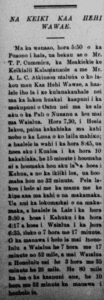
On May 16th, 1893, the Hawaii Holomua newspaper documented a circle-island ride Prince Kūhiō took with two friends. Titled Na Keiki Kaa Hehi Wawae – “The Bicycle Riding Kids” – the article details an 80-mile, 11-hour ride Prince Kūhiō took with two friends that started in Honolulu went over the Pali and through Kualoa, Kahuku, and Wailua before returning to town. Prince Kūhiō is referred to as “Keikialii Kalanianaole” in this article.
On Christmas Day 1894, Prince Kūhiō placed second at a half-mile sprint on the horse racing track in Kapiʻolani Park. He also competed against two pro cyclists visiting from San Francisco in a 10-mile race from Palace Square to Waikīkī in November 1894. Unfortunately he did not finish the race because “his seat turned over near the park and so threw him out” [Hawaiian Star 11/26/1894].
The Rambler Team
By 1894, Prince Kūhiō was a member of the Hawaiian Islans Rambler bicycling team. A team portrait features Prince Kūhio seated in his riding kit (click here for hi-res version). Rambler was a Chicago-based bicycle manufacturer, and it was common in that era for bicycle brands to create riding clubs to promote their products. That’s a Rambler bike in the photo. For a closer look at the bike technology of Prince Kūhiō’s era, here is a photo gallery of a restored 1894 Rambler.
The Cyclomere Park Velodrome
In 1897, Prince Kūhiō competed in a one-mile race at the newly opened Cyclomere Park velodrome. [The Independent 11/2/1897]. Also known as the Kewalo Bike Track or simply the Cyclomere, this short-lived velodrome in Honolulu featured a ¼ mile banked racing track with a grandstand, electric lighting, and a lake in the center. Its location is estimated to be near where Kapiʻolani Boulevard and Cooke Street intersect today. For a hi-res version of this photo click here.
Sources
C.S. Papacostas’ bicycle history series from the March-November 2014 issues of Wiliki o Hawai`i
https://ascehawaii.org/history-heritage-203/
Kamae, Lori Kuulei. The Empty Throne: A Biography of Hawaii’s Prince Cupid. Topgallant Publishing Co. (1980)
Instagram @punipaikikala
https://www.instagram.com/punipaikikala/
Images of Old Hawaii: The Three Princes
https://imagesofoldhawaii.com/the-three-princes/
Nupepa.org
https://www.nupepa.org/?a=d&d=HHA18930516-01.1.1&e=——-en-20–1–txt-txIN%7CtxNU%7CtxTR%7CtxTI———
Digital Archives of Hawaiʻi
https://digitalarchives.hawaii.gov/item/ark:70111/1zcg
https://digitalarchives.hawaii.gov/item/ark:70111/2lrS