
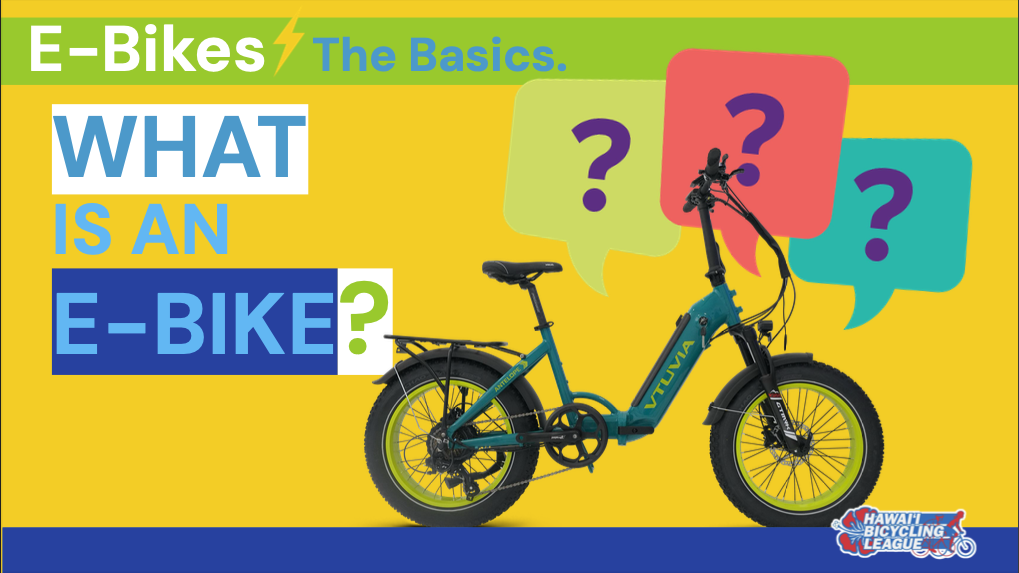
Signed into law by Govenor Green on July 15, 2026, Act 259 made some big changes to improving definitions for electric bicycles, providing better clarification on what is not allowed on public roadways (High-Speed Electric Devices), and modifying helmet regulations for people on e-bikes and bicycles across the state of Hawai‘i.
Hawai‘i’s age restrictions for e-bikes has changed. Here’s what you should know.
E-BIKES ARE NOW DEFINED AS:
Source: Act 259
FORMER DEFINITION:
Hawai‘i has done away with the confusing former definition for e-bikes as well as adopted the national 3-class identification system used as industry standard to update who can ride an electric bicycle.

Of course, just because the age minimum for Class 1 electric bicycles has been lifted, doesn’t mean that parents should look to get their little one on an e-bike as soon as they have a chance – riders should demonstrate they can handle the responsibility that is required to operate an e-bike. That means strapping a helmet on & wearing it correctly every time they ride, obeying all traffic rules, and riding responsibly & respectfully at all times.
E-BIKE READINESS CHECK A Guide for Youth & Parents
Is your child ready for an e-bike?
Age is one part of readiness. Meeting the legal age requirement does not, by itself, tell you whether your child is ready to make decisions in traffic.
- Gear Check
✅ Helmet check: Will they wear it properly every time they ride?
Wearing it properly means it fits them correctly, is buckled, covering the forehead & sitting level.
Do they have the right kind of helmet?
Look for one with an ASTM F1952, NTA 8776, or DOT label. These are specifically designed with more protection for e-bikes with higher speeds.
✅ Bike check: Does the e-bike fit them properly? Can they control its size and weight?
Can they reach the brakes & pedals with ease and understand all the functions of the e-bike?
- Check your Keiki
✅ Skill check: Can they ride a regular bicycle confidently and brake smoothly?
Walk before you run! If you have any concerns with them riding a standard (non-electric) bicycle safely on their own, an e-bike will exacerbate those issues.
- Start, stop, turn, and look behind them while maintaining control.
- Recognize traffic signs and follow signals consistently.
- Check for vehicles at driveways and intersections.
- Slow down around pedestrians and give others space.
- Follow family rules even when friends encourage something different.
- Put their phone away and keep their attention on riding.
✅ Judgement check: Does your child show maturity and sound decision making? Will they avoid risky choices, even when tempted? Consider how consistently they handle responsibility, frustration, and pressure from friends in everyday situations. Physical ability does not equal good judgement. Parents must evaluate if a child can resist peer pressure, avoid distractions like phones, and navigate traffic predictably.
Bicycles & e-bikes are treated as vehicles. Can you count on your child to always ride with the flow of traffic, abide by the traffic lights & markings, not ride distracted, and not with additional people on the bike?
- Following rules without reminders. Will they wear a helmet, stay on the agreed route, and put their phone away when you are not watching?
- Pausing before acting. Can they wait for a clear opportunity to cross rather than follow a friend into an intersection?
- Resisting peer pressure. Will they decline a race, stunt, unsafe passenger ride, or shortcut—even if that means separating from the group?
- Adjusting to conditions. Can they slow down around pedestrians, leave extra space, and change plans when a route feels unsafe?
- Managing emotions. When they are upset, excited, or running late, can they still make careful choices?
- Asking for help. Will they call you about a problem and honestly tell you about a mistake or close call?
✅ Traffic check: Do they know & understand the rules of the road, and will they consistently adhere to them? Do they demonstrate they can pay attention, look for cars, yield to pedestrians, and are able to share the road respectfully?
- Check Your Household
✅ Rules check: Have you set clear family rules before the first ride?
✅ Charging check: Does your child know where they can safely charge their e-bike battery?

Remember…
Before children ride an e-bike, they must first understand how to be safe pedestrians and then learn to be safe bicycle riders so they do not injure themselves or others.
Safe e-bike riding requires training, good judgment and mature decision-making. Being able to ride a regular bicycle does not automatically mean a child is ready for an e-bike.
Parents should carefully consider their child’s age, maturity and riding skills before allowing them to ride. With the right training, supervision and safety equipment, families can help reduce the risk of serious injury.
Additional Resources:
Learn more about Act 259 – read our breakdown & overview of this 25-page new law here.
Enroll in an E-Bikes 101 workshop in a neighborhood near you, offered by HBL for free for parents, families, & individuals across O‘ahu. Check out the full listing of hands-on and on-bike learning opportunities here.
AAA E-Ride Safety Guide – What parents and riders need to know about electric bikes and scooters.
FAQ
WHAT'S AN E-BIKE?
WHAT'S AN E-BIKE?

- Has functional pedals
- Electric motor not more than 750 watts (1 hp)
DO YOU NEED A DRIVER'S LICENSE OR PERMIT TO RIDE AN E-BIKE?
DO YOU NEED A DRIVER'S LICENSE OR PERMIT TO RIDE AN E-BIKE?
No driver license, permit, or ID is required to ride an e-bike anywhere in Hawai‘i.
Hawai‘i mandates no coverage for any e-bike, and Hawai‘i’s Act 259 writes the exemption directly into statute.
Registration required.
Every e-bike carries a permanent $30 registration paid to the county director of finance (HRS 249-14); Hawai‘i Act 259 adds citation or impoundment for riding unregistered.
WHO CAN RIDE AN E-BIKE?
WHO CAN RIDE AN E-BIKE?
There is no minimum age to ride a Class 1 e-bike, but for Class 2 and Class 3 e-bikes riders under 16 need direct supervision by a parent or legal guardian.
E-bikes are considered vehicles in Hawai‘i. Operators should know how to ride a traditional bicycle before getting on an e-bike.
ARE E-BIKE DANGEROUS?
ARE E-BIKE DANGEROUS?
E-bikes are not dangerous on their own, but when combined with a person operating it in a reckless or careless manner they can be just as dangerous as any other vehicle on the road. Riders should be equipped with the necessary maturity and focus to interact with others in a shared space and physical ability to control and safely operate the vehicle.
WHERE CAN E-BIKES RIDE?
WHERE CAN E-BIKES RIDE?
In Hawai‘i, a low-speed electric bicycle may be operated in any place where a bicycle is allowed to operate,
including but not limited to streets, highways, roadways, shoulders, bicycle lanes, bikeways, and bicycle or multi-use paths. E-bikes have the capability to move people faster than traditional bicycles, so e-bike riders need to use caution, especially on trails or areas where drivers may not expect a bicycle rider to be moving as fast.
- On-street bicycle facilities (like bike lanes & protected bike lanes)
- Shared-use paths - counties can impose their own restrictions, look for posted signs
- Public roadways (with and without bike lanes)
- Residential sidewalks (under 10 mph)
- Sidewalks in Business Districts